- How much water is used by a data center?
AI generated answers are quick, fun and exciting. Similar to Google, but better than Google, AI chatbots provide answers to all our questions, codes like a pro, analyzes uploaded question papers, creates images and videos and seems to gain more power with time. But there is another dark reality to AI.
AI responses require a lot of water. How does this happen?
Before we see what water is needed and how much, let us see what is meant by a data center.
A data center used to be a simple supercomputer in earlier days, but now it is a complicated and huge system with servers, cooling towers, facility systems, support infrastructure, networking components and many other similar components.With our entire digital world being “dataified” numerous infrastructures is needed to run these data intensive jobs.
In order to answer our questions, the machines hosting the LLMs and the data center is working hard behind the scenes. The specialized chips in the machines heat thinking and working out the answers. The heat that is generated by the many sets of machines needs to be cooled and this requires constant running water. This brings the reality of cool water for running data centers and a lot of water is needed considering the number of questions asked and the number of answers that have to be given. Compare it a mobile phone getting heated or a laptop getting heated due to overwork.
Asking a small question might not look like it is using a lot of water but a lot of users making such queries drains water resources.
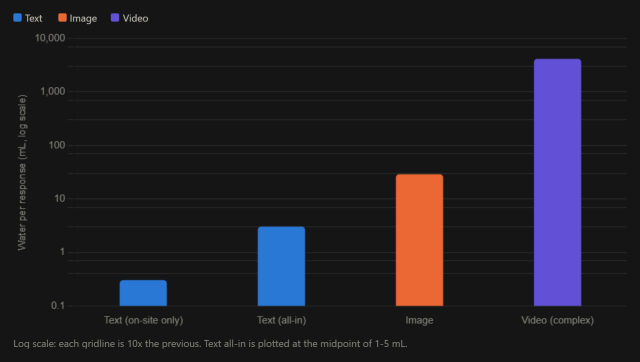
A rough estimate by Claude states that one image uses about 0.25 ml – 0.32 ml of water per response. Complex videos use approximately about 4.1 L of water per response. It is not the single image or video creation that uses much water but the cumulative usage of water by millions of users and the edits and re-edits they do to the images and videos that puts a strain on natural resources.
2. What is the best way to ask questions to LLMs for safeguarding your privacy?
The best way to ask any of the LLMs like ChatGPT or Claude questions when safeguarding your privacy is to ask it by being logged out. Image generation does need you to be logged in, but for most other things, you can ask questions without being logged in to safeguard your privacy.
In light of the discussion in the first question, it is prudent to use AI as and when absolutely needed.
3. What is the meaning of “AI agents going rogue”
When AI agents are said to be going “rogue” it means that they are trying to finish goals at any cost. There were not enough “guardrails” to hold them back. So, they broke free and accessed other models since there was a path there and they could complete their goals.
AI models can spot vulnerabilities much more easily and effortlessly than human efforts. This enables AI models to login into websites if passwords are left in the open or any other means.
It is like when a marathon runner is told to finish the race but has not been told the path to reach the destination. He goes through any path to reach the destination keeping the mileage in check.
We discussed a few questions about AI that are in everyone’s mind today. Join me as I discuss more questions about AI in subsequent posts.
This post is for Blogchatter Half Marathon.
Hi Jayanthi! This is a clear, timely set of FAQs. What I’ll take away is the cumulative water use, rather than any single prompt, and the simple privacy habit of asking while logged out. Looking forward to more posts from you.
Yes, as convenient and widespread as AI has become, we need to take into account the environmental costs of its usage. It’s better to use normal search engines for simpler tasks and limit AI use as much as possible to curb the environmental impact.
Nice sweety 🙂